City Moon, Country Moon: Writing Local Night-Sky Poetry Where You Live
Most moon poems are written by people who have never looked at the moon. Not really—not from the fire escape at 11:40, not past the pharmacy sign with two letters burned out, not across the field where the irrigation pipe ticks all night. The moon in those poems is a generic silver coin. The moon outside your window is a different animal entirely, and it is the one worth writing about.
Local night-sky poetry begins with a simple shift: stop borrowing the moon from literature and start observing the one you can actually see. It might be dim, late, obstructed, or strangely orange. That is not a problem. That is material.
Begin with the Rectangle of Sky You Actually Have
Every writer has a personal aperture. It may be a kitchen window framing a brick wall and a slice of sky, a tenth-floor balcony with an unobstructed view east, or a driveway where the moon clears the treeline around nine. Find yours before you write a line.
Stand still for ten minutes and note what enters and leaves that frame. Which building edge does the moon cross? How long does it stay visible? What passes in front of it—a plane, a cable, a flock of geese, a neighbor's bathroom light switching on? These are the details that make a poem feel located rather than decorated.
Write down the answer to three questions: Where do I stand? What blocks the view? What else is in the frame? Keep these notes short and unpolished. They are raw material, not drafts.
Learn Your Local Moon's Habits
The moon behaves differently depending on where you live, and not only because of light pollution. In a city, it often arrives late and low, diluted by streetlight, and seems to slide across a narrow band of sky above the roofline. In the country, it has room. You can watch it lift off a horizon of corn stubble or dark hills and keep watching until it is overhead.
City Moon
City moonlight is not really light; it is a change of tone. Wet asphalt holds it. A parked car's roof holds it. Laundry on a line goes pale blue. Practically, this means your city moon poem probably needs other light sources in it: the orange wash of sodium lamps, a phone screen, a security light clicking on. Contrast is the whole story. Notice how the moon looks weaker than the signs and then, at some point, strangely more permanent than they do.
Country Moon
Rural moonlight is generous, and that generosity is a trap. It invites easy adjectives—silver, vast, silent—that have been used until they are worn smooth. Resist them. Instead, record what the light does: the shadow of a fence post falling across gravel, a dog's eyes catching it, the way a gravel road turns into a ribbon of pale water. Distance matters too. In open country the moon seems smaller and higher; near a horizon, it looks swollen and close. Both are true. Write the one you saw.
Collect Nouns Before Adjectives
Adjectives are where moon poems go to die. Nouns are where they come alive. Before you write about the moon, spend a week collecting the ordinary objects in your neighborhood or landscape that it touches: water tower, fire escape, satellite dish, bus shelter, silo, cattle grid, chimney pot, tram wire, grain elevator, recycling bin.
Then add the local sounds and smells—a train horn, a gate latch, cut grass, diesel, woodsmoke, somebody's television through a wall. A poem becomes specific the moment it admits that the moon is shining on a takeaway container.
A Field Method: Ten Minutes, Three Drafts
Observation without a method drifts. Try this sequence, which works in a back garden as well as on a fire escape.
- Look first, write nothing. Give it three minutes. Let your eyes adjust and your expectations drop.
- Note five concrete facts. Not feelings. Position, phase, color, obstructions, weather. "Half moon, low, above the corner of the parking garage, sky hazy."
- Note three sounds and one smell. This anchors the poem in a body, not just a view.
- Draft a single sentence with no metaphor. Plain description, as accurate as you can manage. It will often become the spine of the poem.
- Write a six-line draft on the spot. Do not edit. Do not reach for the word "luminescent."
- Go inside and write a second draft from memory, thirty minutes later. What survived is usually what the poem is really about.
Three Vantage Points Worth Trying
The Window
The window is the most honest vantage point because it admits constraint. You are indoors. The glass has a smudge on it. A reflection of a lamp floats over the moon. Use that. Poems written from windows tend to be quieter and more interior, and the moon is often less a subject than a visitor.
The Rooftop or Stairwell
Getting above the street changes the scale of the city: rooftops, vents, aerials, the tops of trees. Access matters, so be realistic and safe about where you go, and never onto a roof or fire escape you are not permitted to use. The payoff is a wider frame and a certain verticality—the moon above a skyline feels more like distance than decoration.
The Rural Horizon
Find a field edge, a low bridge, a gate, a hill road with a clear line east. Arrive before moonrise and wait. Watching something appear is different from watching something already there, and that difference shows up in the writing. Bring a coat and a torch you keep off.
Drafting Exercises to Loosen the Local Detail
- Address the moon as a neighbor. Not a goddess. A neighbor who keeps odd hours and leaves the hall light on.
- Write a poem that never names the moon. Describe only its effects on your street. This forces observation.
- Use a map. Include two real place names from your area—a road, a bridge, a shop—and see how they change the poem's temperature.
- Write the same poem twice: once from your window, once from a field ten miles out. Compare which version has more energy.
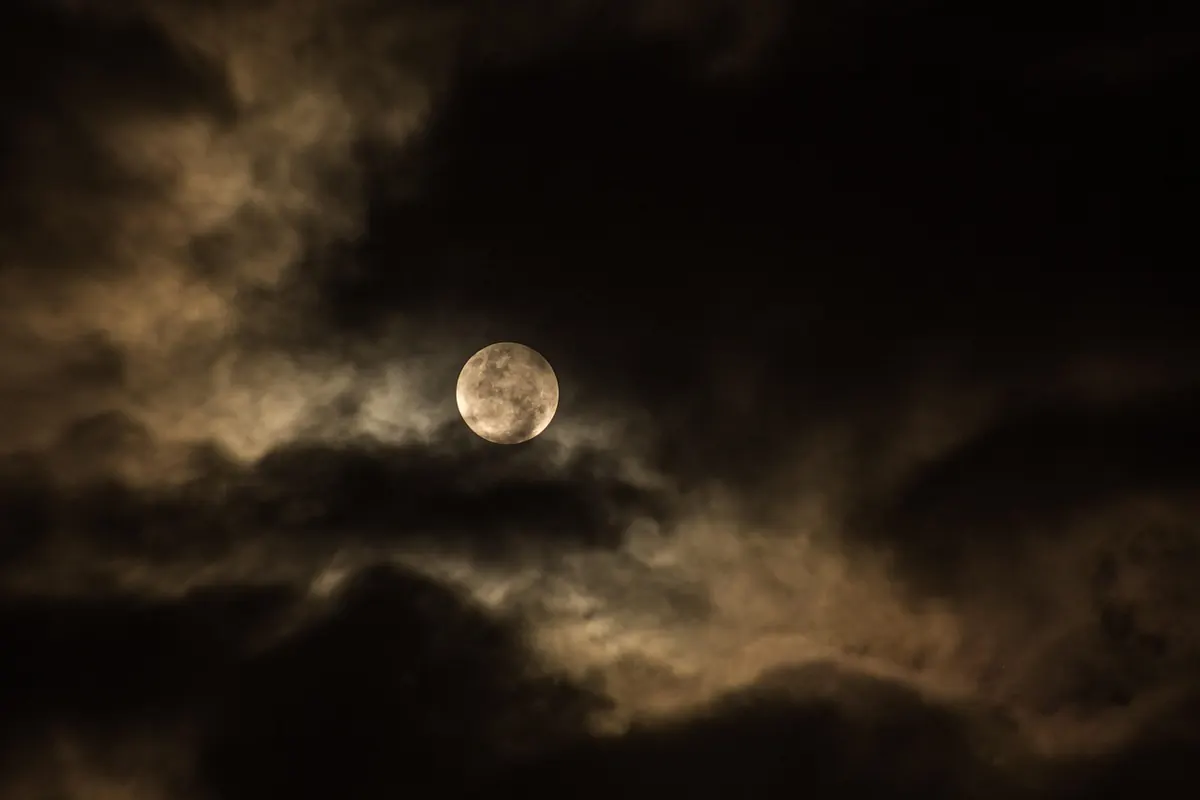
- Record the weather. Cloud, haze, drizzle. The moon under a thin cloud is a different moon from the one in a clear sky, and readers know it.
Revise Toward the Specific
Read your draft and underline every adjective attached to the moon. Replace each one with a fact or cut it. "Silver" rarely earns its place; "the color of a coin under water" might, if that is honestly what you saw.
Then apply the relocation test. If the poem could be set in any city or any field, it is not yet local. Add one detail that could only belong to your street: the name of the takeaway, the shape of a water tower, the particular click of a gate. One is enough. Three is a travelogue.
Finally, read it aloud at night, ideally near the window it came from. Lines that feel literary in daylight often go soft in the dark, and the ones that sound like speech usually survive.
Keep a Local Moon Log
Buy a cheap notebook and keep it by the window. Each time you notice the moon, write the date, the time, where you were standing, and one sentence about what it looked like. Two minutes, no more. After a few months you will have something more useful than inspiration: a record of your own sky, with its obstructions, its seasons, and its recurring noises.
Poems grow out of that record. Not every entry will become one, and it does not need to. The practice is the point—looking up from where you actually live, then writing down what you saw with enough accuracy that a reader standing on your street would recognize it. The moon has been written about for a very long time. Your corner of the night has not.
Photo: Bessi / Pixabay